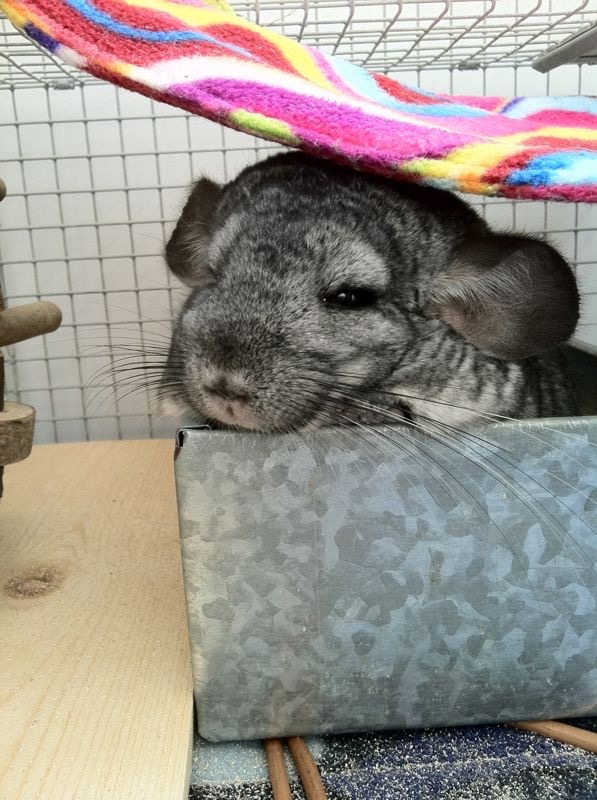
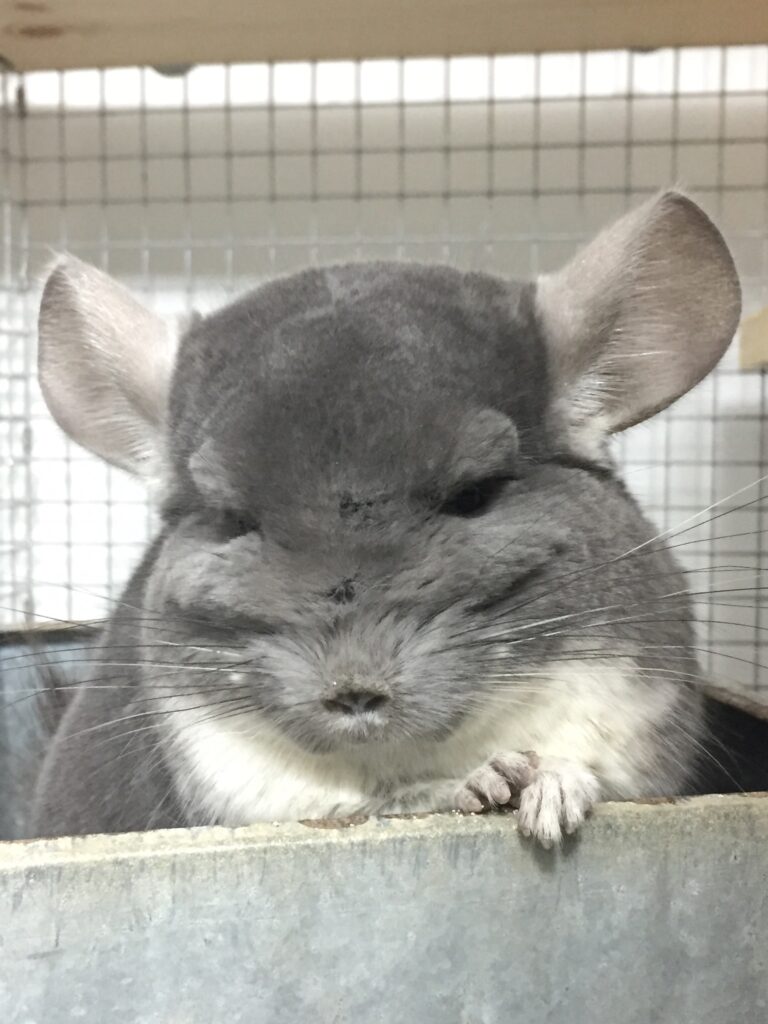
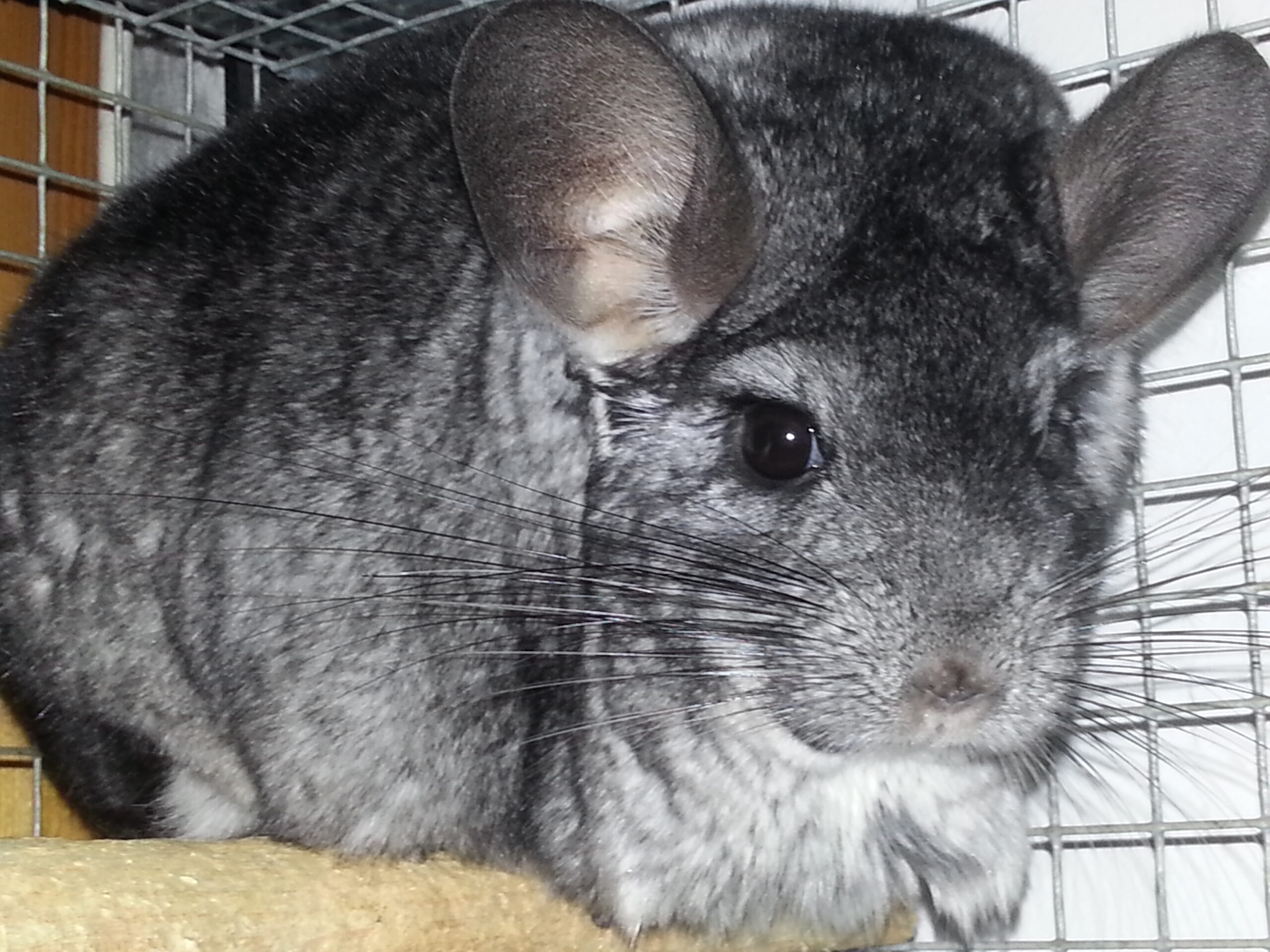
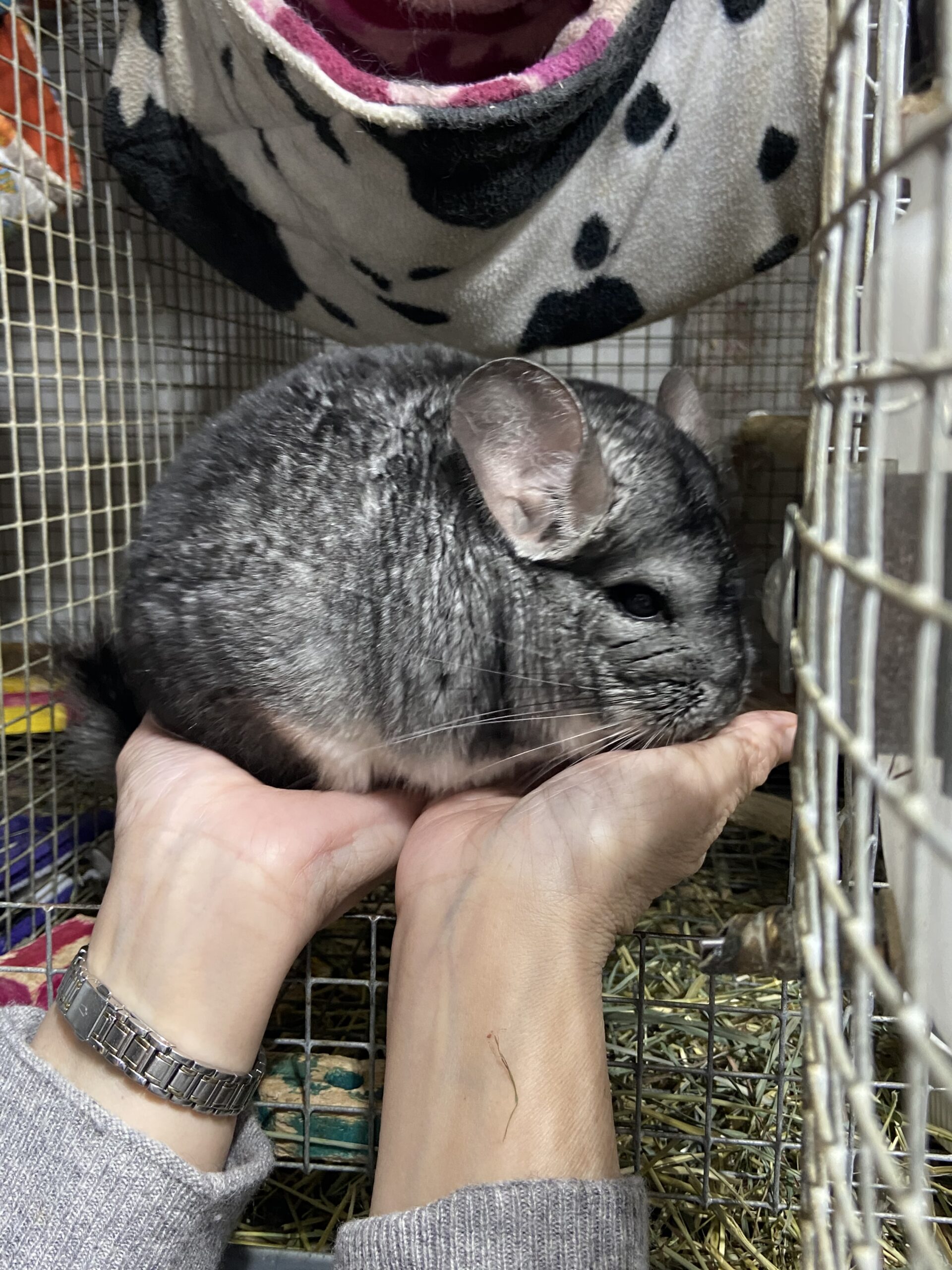
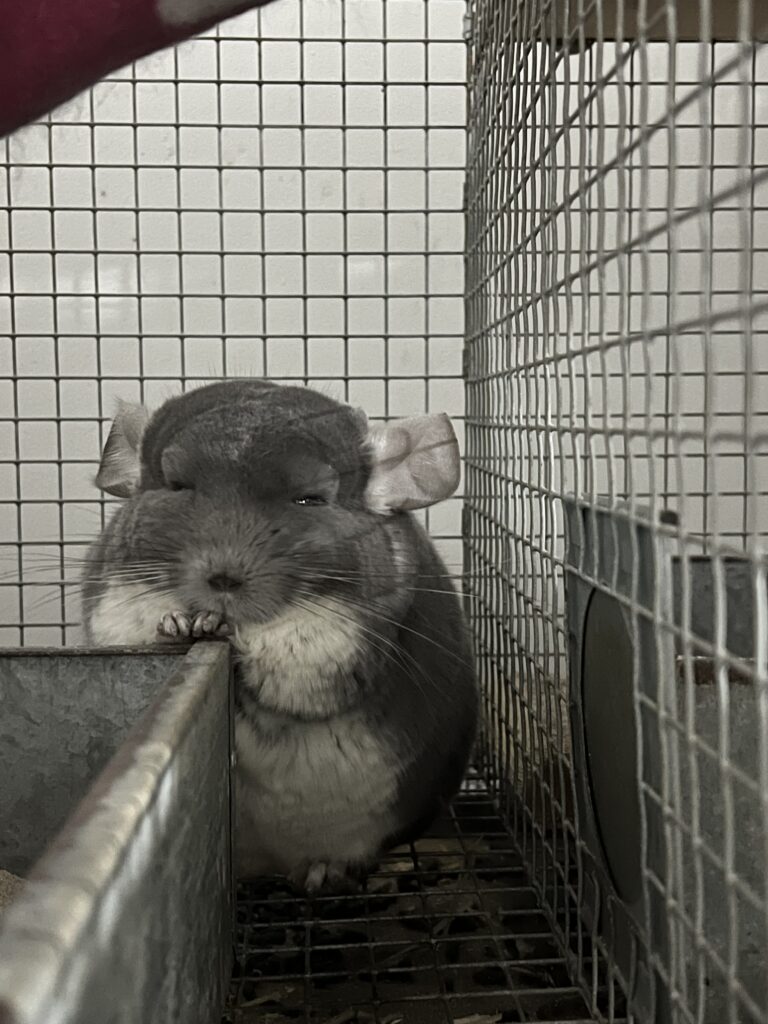
So you’ve got the cage, you’ve got the food and hay, you’ve got the chinchilla …. what now? Well, in my experience, first time chinchilla ownership can be confusing and contradictory. There’s a lot of information available and some of it is right, some is wrong, and some is down-right dangerous.
Owning a chinchilla is 90% observation. Keeping your eyes peeled on the chinchilla’s behaviour, food intake, droppings and urine output, and cage/environment are keys to healthy, happy chinchillas.
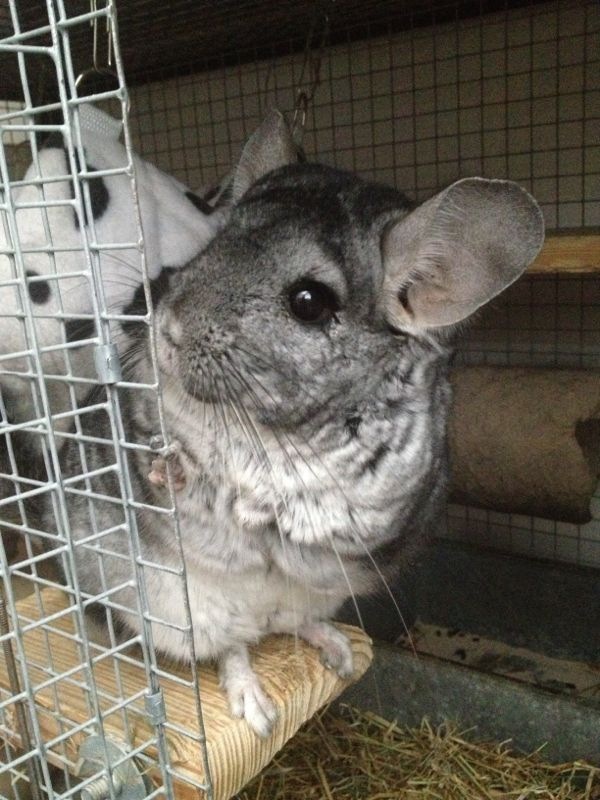
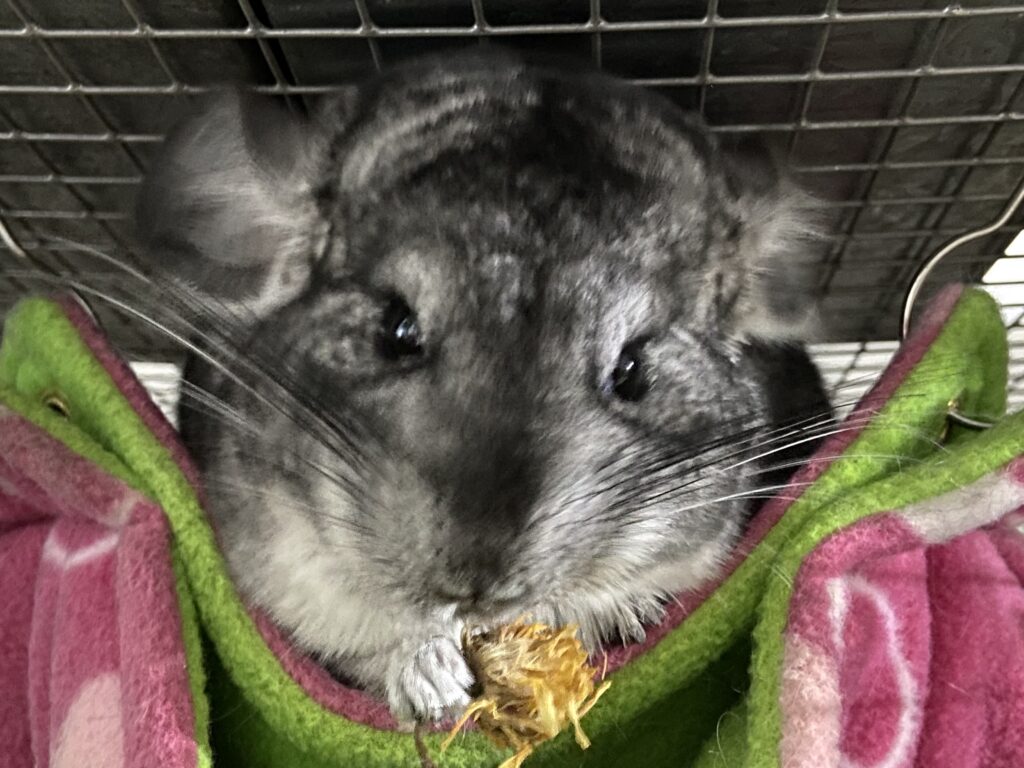
Gzifa Chinchilla peering around the cage door.
The First Few Days – What to Expect
A chinchilla will take time to settle into its new surroundings; new sounds, new cage, new smells, new humans to get used to. It’s a lot for a small furry, whose natural behaviour is as a prey species – you may find your new companion hides for the first few days. Don’t worry – once your chinchilla gets used to everything, they will ‘come out of their shell’. Chinchillas are curious and love to explore.
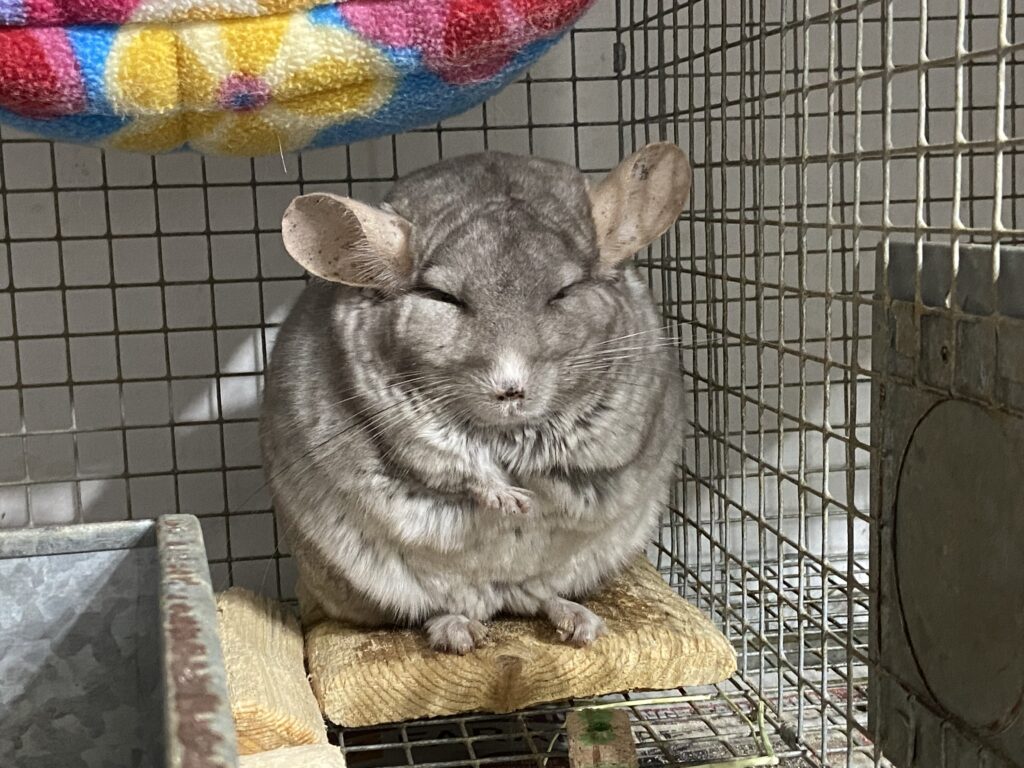
Your chinchilla may produce an alarm call. This sounds like a squeaky dog toy and is a signal (to other chinchillas) that there is danger present. In my experience, the faster and higher pitched the call, the more ‘dangerous’ something is – chinchillas have good hearing and often hear things before we do. One of my chinchillas used to alarm call when planes were going overhead – he heard those planes before I did. Having said that, chinchillas sometimes alarm call in their sleep. This is often a very slow, quiet call and the chinchilla appears fast asleep; eyes closed and in a relaxed pose.
Your chinchilla may take a day or two to settle into eating normally. It is essential that the chinchilla is eating its pellets, hay and drinking. Check the cage floor for droppings, any wasted food, or discarded hay. Also check that the water bottle is working and the water level is going down.
Once the chinchilla is used to its new environment, you will find it comes out of hiding and begins to explore. At this point, it is very tempting to try touching and stroking the chinchilla. Personally, I would avoid this temptation and just sit patiently beside the cage, softly talking to the chinchilla until it comes to you. You don’t want to frighten it. You want the chinchilla’s first experiences with you to be gentle, calm and non-threatening. When the chinchilla comes to the front of the cage, take some time to continue talking softly – don’t open the cage door or put your fingers through the cage bars. Chinchillas nibble first and you may get your finger bitten.
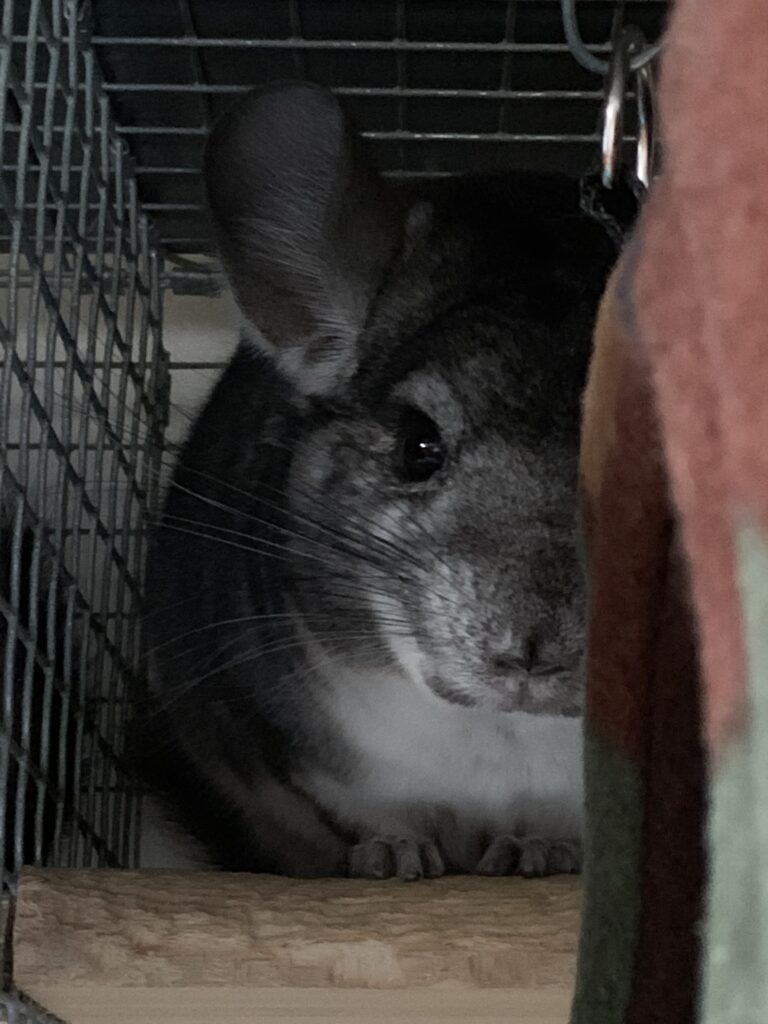
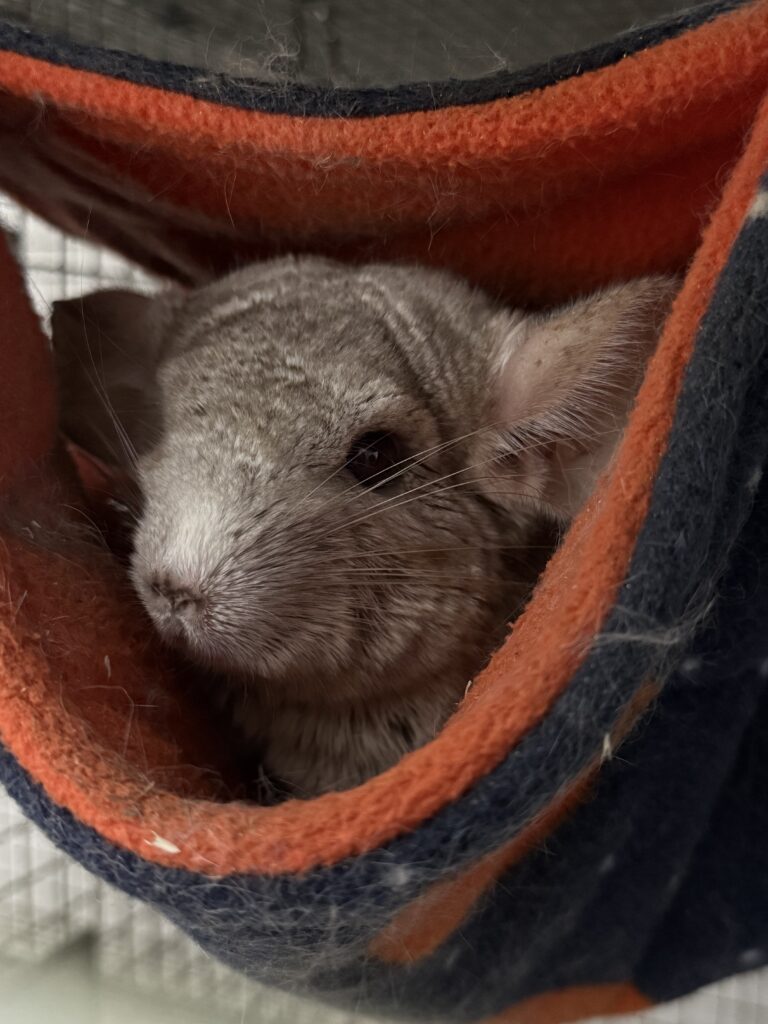
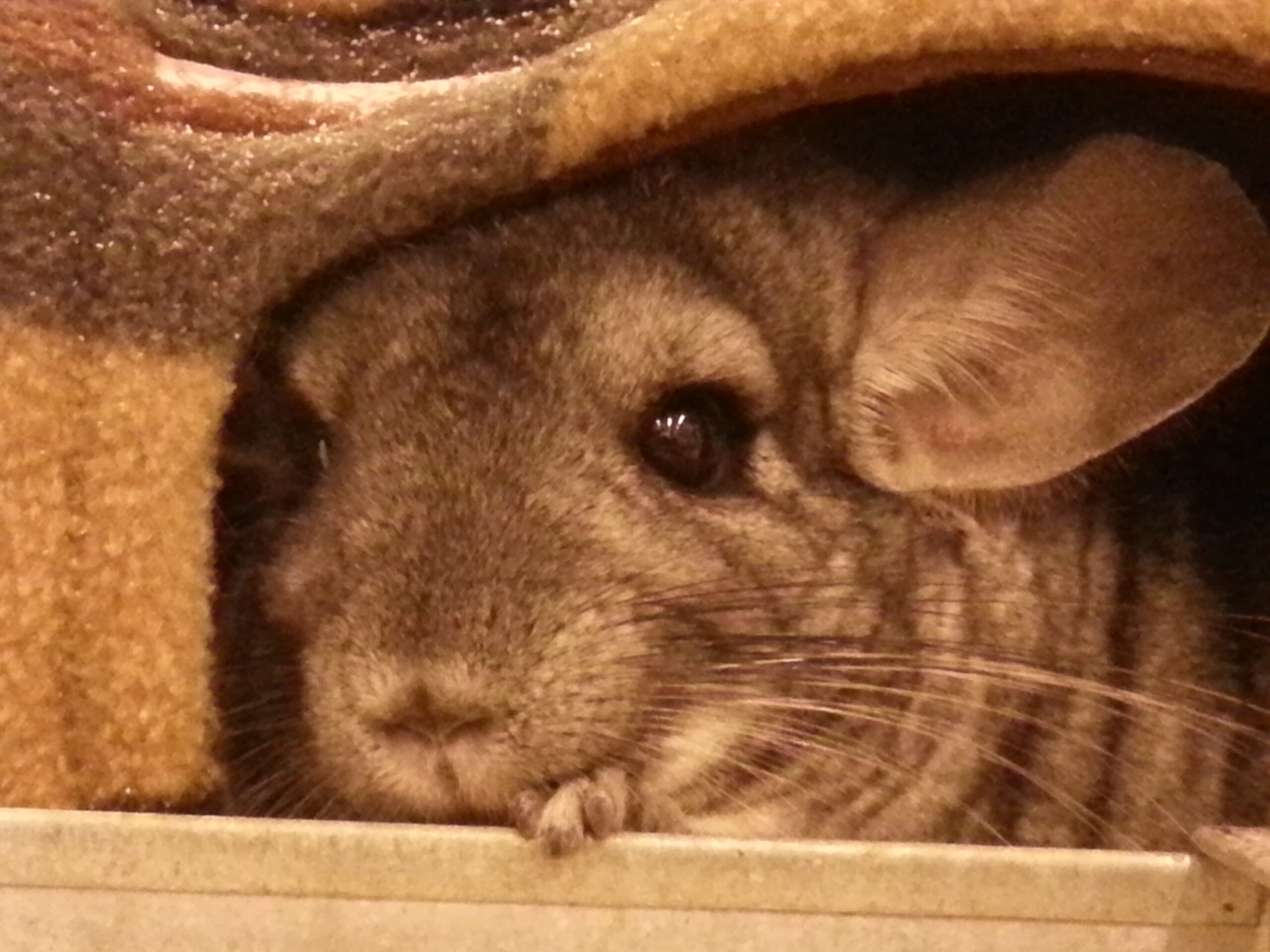
Chinchilla peeking out from behind a fleece house.
Once the chinchilla is comfortable with you being near the cage, you can carefully open the door and place your hand on the edge of the door. Wait until the chinchilla comes to examine your hand. Stay still and let them sniff, touch, and (possibly) gently nibble your fingers. If the nibbling is a bit too hard, you can make a “cack” sound but try not to pull your hand away. The ‘cack” sound is a warning/cross noise that chinchillas make when they are being groomed too hard or are irritated by something that is being done to them.
This may all take several days – patience is the key here. Take your time.
Once the chinchilla is used to you putting your hand in the cage door and is happily exploring you, it’s time to move on to the next step.
Mutual Grooming
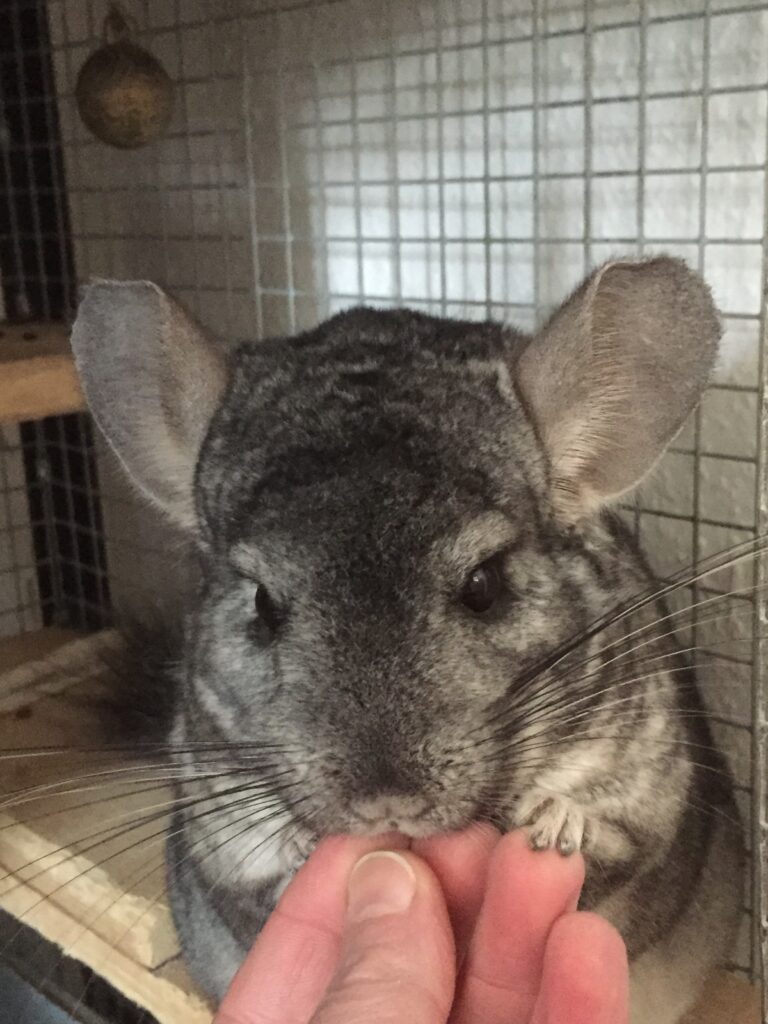
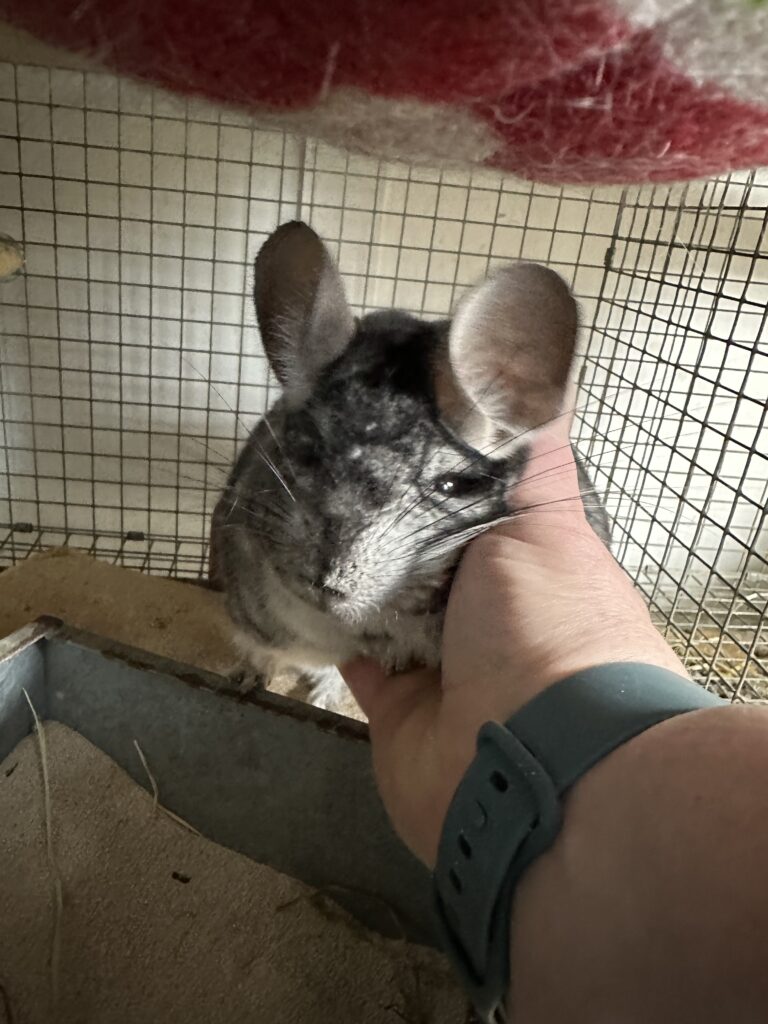
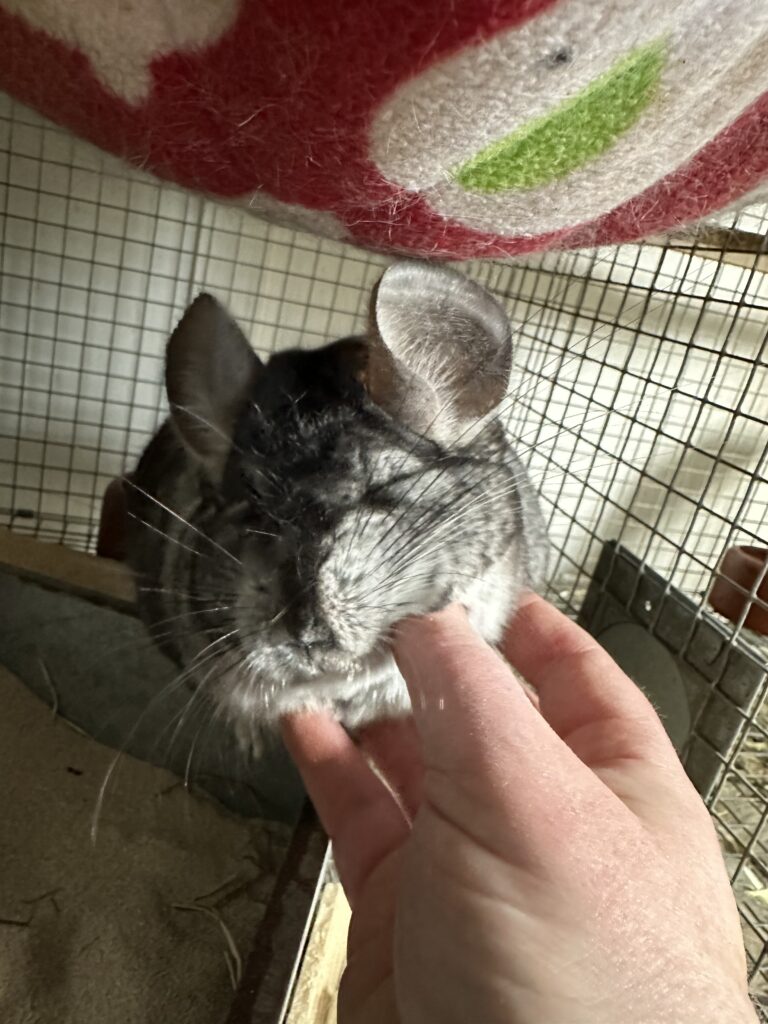
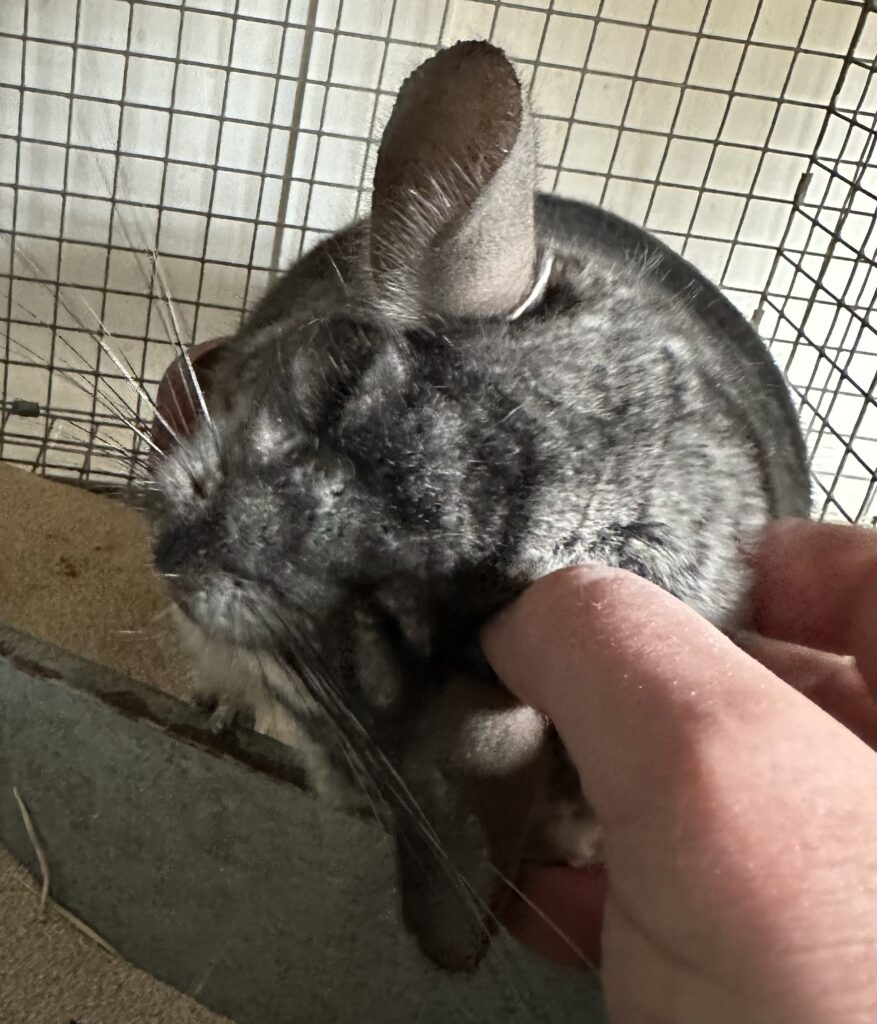
Chinchillas like to groom each other. It’s a sign of bonding and is lovely to watch. With a single chinchilla, you become their companion so it’s important you learn how to groom them. With gentle fingers, scratch around the chinchilla’s face, ears, and chin. Some chinchilla prefer certain spots for being groomed – several of my chinchillas love to have their lower jawline scratched. I take two fingers and very gently pinch the skin along the jaw, from front to back. If you get the right spots, often the chinchilla will tilt their head and/or lift their front paw in an attitude of bliss. Their whiskers will also go up or forward, depending on where you are tickling them – as these photos show.
Chinchilla exploring fingers. MacPeeps having chin scritchesMacPeeps enjoying his chin scritchesMacPeeps having ear tickles
With patience, the chinchilla may reciprocate and groom you back. Gentle nibbles of your fingers, hair on the back of your hands or arms, eyebrows (making sure they don’t chew them off), or your nose, lips, or eyelashes. anything on your hands may be nibbled such as rings, finger nails, or anything they can reach – glasses, zips, sleeves or other clothing, and hair. If a chinchilla is grooming you back it is a sign that they are relaxed and trust you. It’s a real privilege to be considered “one of the herd” and groomed. Enjoy it when it happens – you’ve made a friend.
This is just a quick guide for anyone thinking about buying a chinchilla. Established chinchilla owners should know the basics already.
It is worth considering whether or not a chinchilla is the right pet for you.
Below are some general pros and cons on chinchilla keeping. These are based on my own experiences. Please remember that there are exceptions to every rule.
Is a chinchilla a suitable pet for you?
* Chinchillas can be nervous and highly-strung. Therefore are not always suitable pets for very young children or very busy, noisy households. They are able to adapt if given peace and quiet at times.
* Chinchillas have very delicate skeletal structures and can be easily injured with clumsy or heavy-handed handling. Young children may be so excited by handling a chinchilla that they try too hard and are accidentally too rough. Supervision is always necessary.
* They can take a long time to settle down and overcome their natural fear of people. They need time and patience when settling them into a new home.
* Chinchillas can live for over 20 years – although 8-10 years appears to be the average life-span. They are a long-term commitment like a cat or dog.
One chinchilla or a pair?
Chinchillas do like company and are social animals, therefore:
* If kept alone, they require plenty of daily attention (and reasonable exercise) to avoid boredom and loneliness. Single chinchillas can bond with their owner and make great companions.
* It is not recommended to keep mixed sex (male/female) pairs together. Breeding chinchillas is not for the beginner – there are associated care needs to consider. For example, spare cages will be required for weaning litters. Also for separating the female from the male periodically, to avoid over-breeding. Male chinchillas can be castrated as a final option. However, all operations carry a risk and a good chinchilla-competent vet is a must.
* Same-sex pairs can be kept together, provided they have been slowly introduced to each other (preferably as youngsters). Caution should be taken when caging males together; they have been known to fight when they reach maturity or if nearby females are in season.
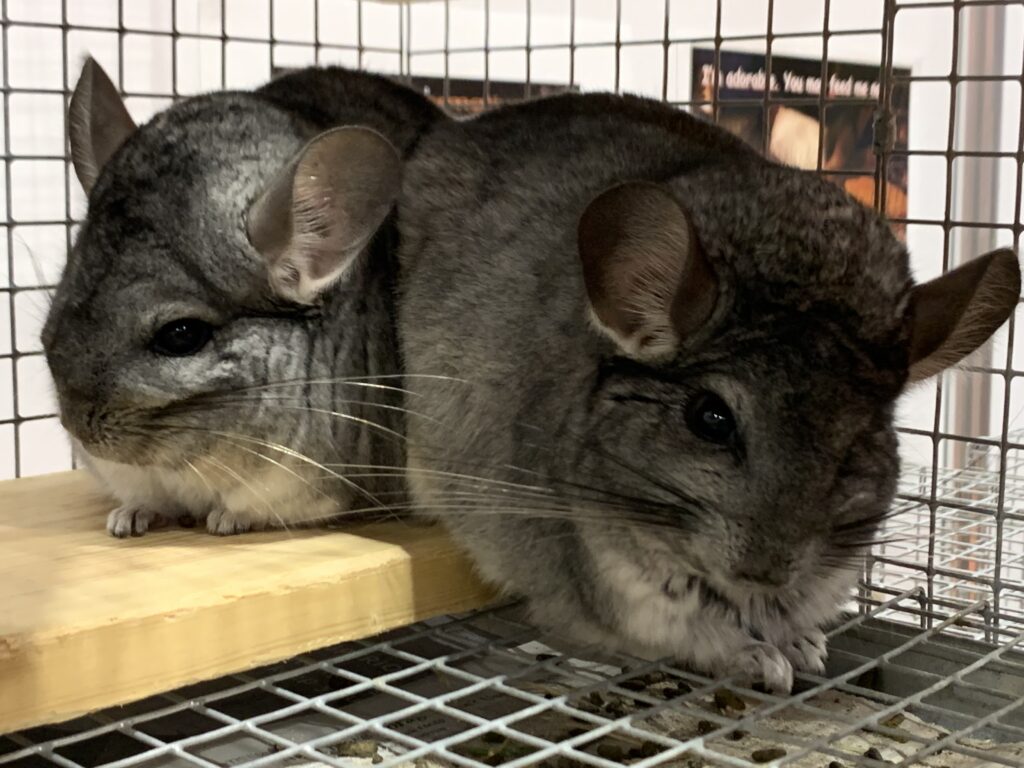
A pair of standard grey chinchillas in a cage
* Although chinchillas can adapt to your life-style to a certain extent, they are generally crepuscular by nature (most active at dawn and dusk), and can be noisy during the night, especially if kept in a bedroom.
* Their diet of hay and the need for a regular dust bath can prove to be problematic for asthmatics or anyone with allergies.
* Chinchillas are not always compatible with other pets. For instance; noisy parrots kept in the same room can cause stress-related behavioural problems in chinchillas. The same is true for cats and dogs, who are predators to chinchillas. There is also the potential for diseases to spread from one animal to another (called, zoonosis), such as pasteurella that can be fatal for chinchillas. It is worth considering if you can provide a room specifically for the chinchilla so that other animals cannot access them or their cage.
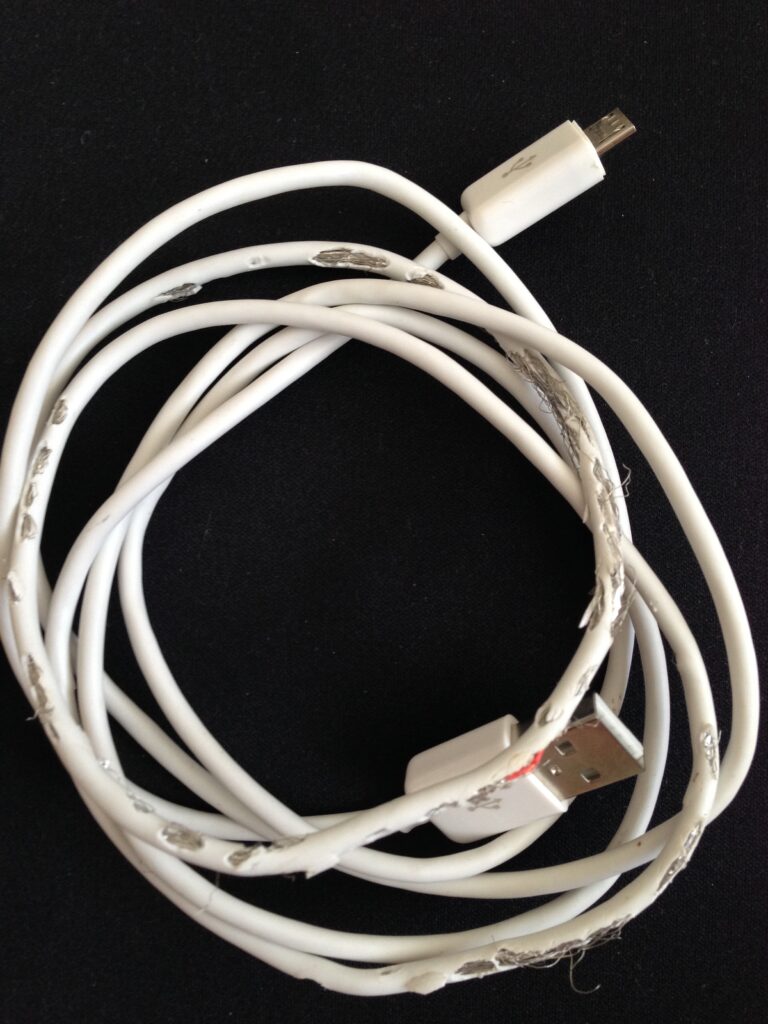
* Chinchillas chew absolutely everything. They can be very destructive if allowed free-access around the house for exercise. Their instinct is to chew not only hard objects such as chairs and tables but also wires. It is important to “chinchilla proof” an area of the house to preserve your furniture and electronics.
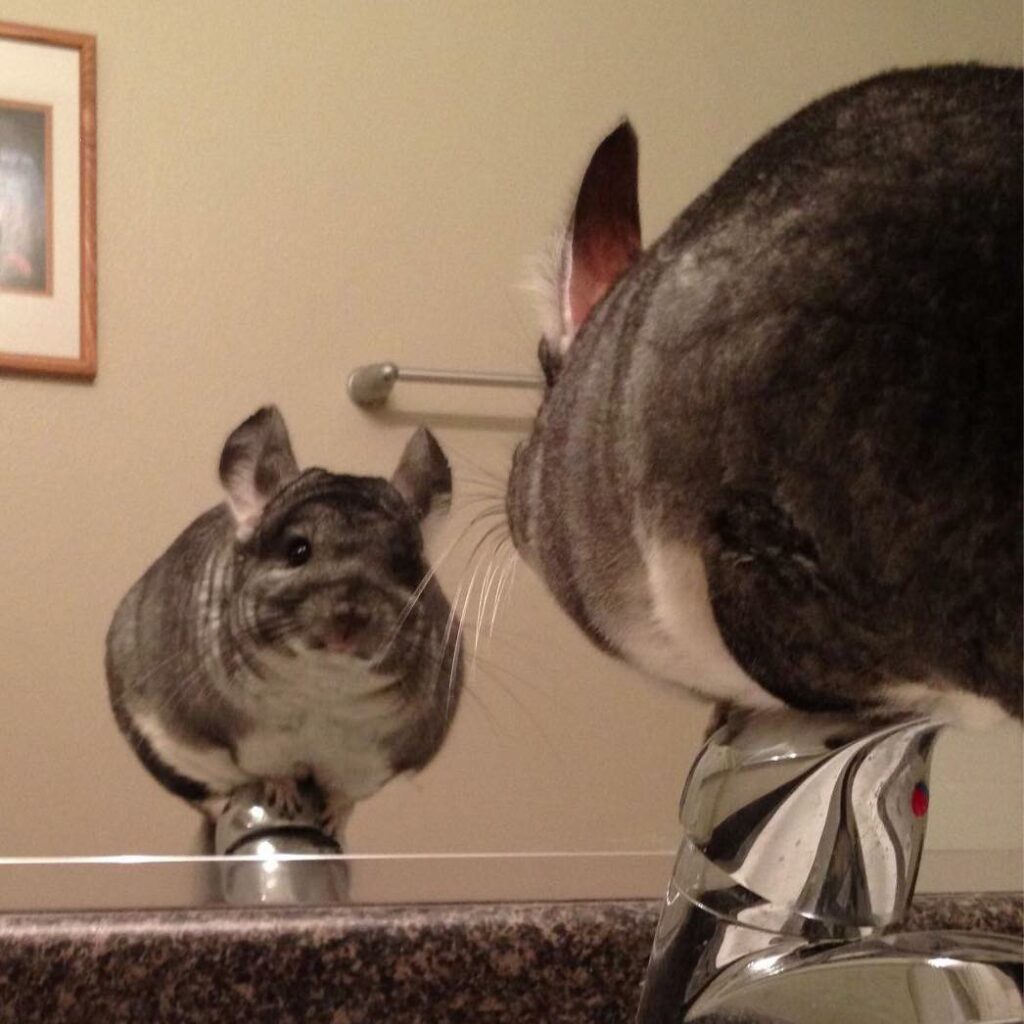
* Remember to keep those toilet seats down too. Sadly, chinchillas have been known to jump into a toilet when the lid has been left off, with fatal consequences.
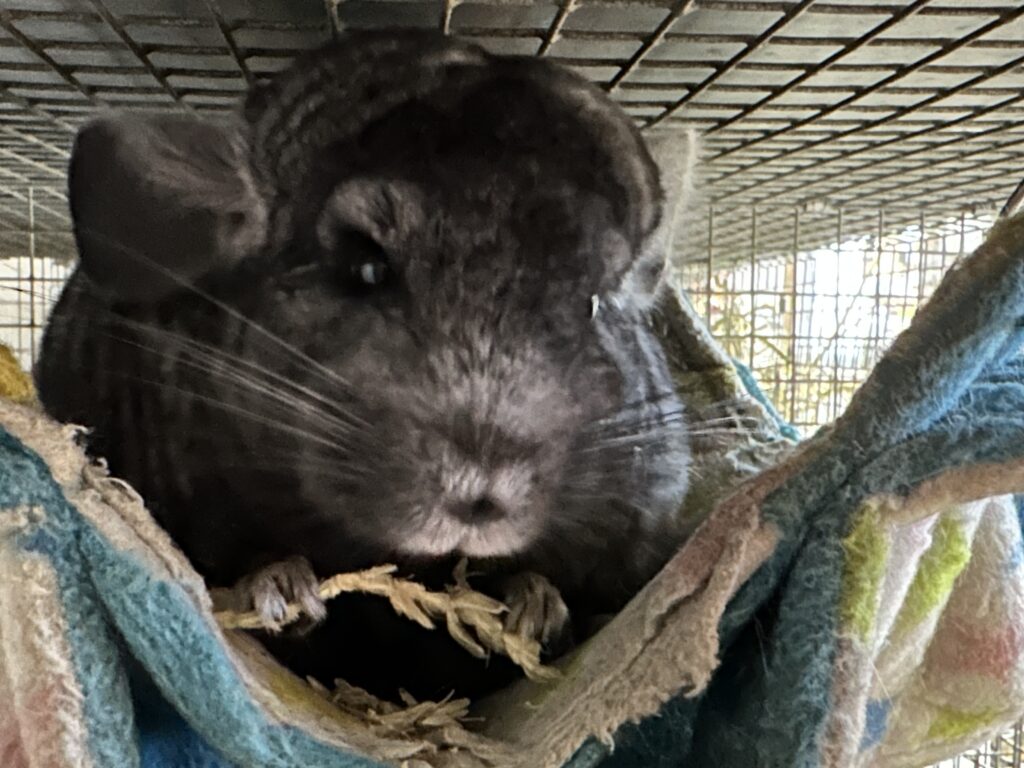
A cable chewed by a chinchillaA chinchilla exploring a bathroom (credit – Cindy – Chins n Hedgies forum)A chinchilla with a chewed fleecy hammock
Where to buy a chinchilla
The recommendation is to purchase privately or from a breeder, it is rare to find a chinchilla in a pet shop. Pet rescues may also have chinchillas for rehoming, although there are not many specialist chinchilla rescues (in the UK, at least). Chinchillas are available to purchase online. The caveat of “Buyer Beware” always applies.
There are several things to consider when purchasing a chinchilla privately:
* You may be able to get some background history with your chinchilla, which is important if considering purchasing breeding stock, as some problems can be genetic/hereditary.
* You should be able to get an accurate age of the chinchilla you intend to purchase.
* You should also be able to get some experienced advice on their care and husbandry requirements.
* If possible, continuing with their current feed is important. When purchasing a chinchilla, ask or buy for some of their pellets. Many breeders will provide some pellets at the time of sale. Sudden diet changes can cause serious stomach upsets so it is best to avoid this.
* Accessories and equipment may also be available at “cheaper-than-petshop” prices.
* You can also take your time to evaluate and look-over the chinchilla as it should be more relaxed in its familiar environment.
Murphy, violet chinchilla in a dust bath.
What to Look For
* Bright, wide-open eyes, with no signs of discharge or flattening of fur around them.
* Ears that are clean and held erect. Sleepy chinchillas often have their ears held flat against their head.
* Nose – clean and dry.
* Genital/anal regions clean and dry and free from soiling.
* Fur should be velvety and plushy-looking with no matted or bald areas.
* The chinchilla should feel firm and solid and certainly not bony when handled.
* The front incisors should be even and chisel-shaped, and a dark yellow to orange colour (if the chinchilla is adult).
* Droppings should be of normal appearance (dark, smooth, plump and oval – like a small cavy dropping).
Normal Chinchilla Behavioural Responses
Chinchillas may be nervous around strangers, but don’t let that put you off. A healthy chinchilla is a naturally curious animal and if you place your hand quietly in its cage it should eventually come forward to gingerly sniff and explore your hand.
There are few differences between males and females, and both make suitable acquisitions as pets, with regard to their general behaviour.
A frightened or unsocialised chinchilla may spray you with urine or rear up onto its back legs, baring its teeth and “growling” at you. They may still make good pets eventually, with time and patience, but some people may prefer to start off with a chinchilla that is slightly less intimidated by people.
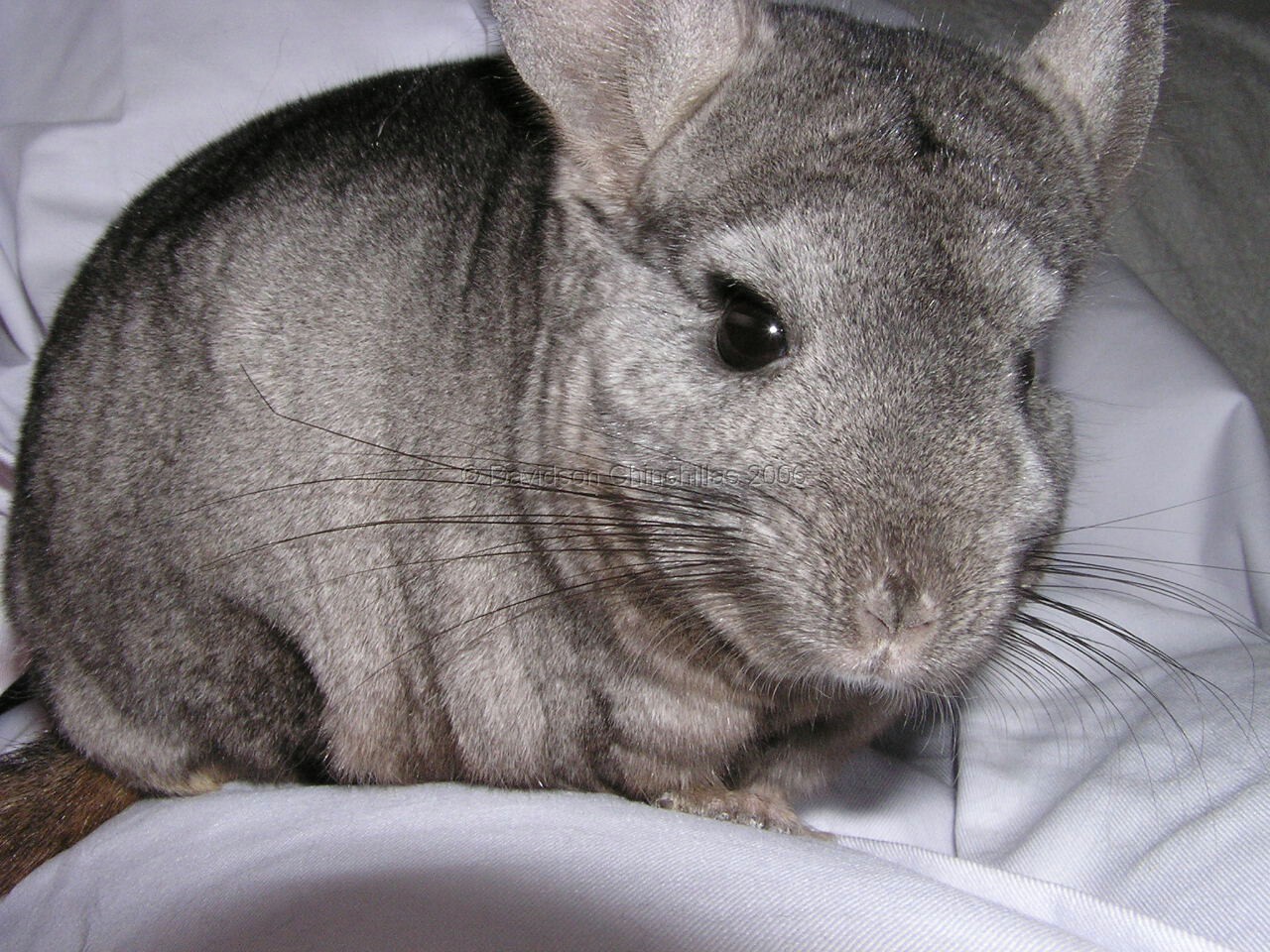
Griselda, an older female standard chinchilla
Transporting your new chinchilla home
* Always bring a suitable chew-proof container to transport your new pet home in. Some breeders will allow you to buy a small show-cage from them, which doubles as a carrying cage.
* Flimsy cardboard boxes are not suitable for long journeys, as chinchillas are quite capable of chewing large holes in them, in a relatively short period of time.
* Although most chinchillas will not eat during transit, a handful of hay should at least be offered if the journey is likely to exceed 2 hours.
* DO NOT be tempted to travel with a chinchilla if it is a hot day. Chinchillas are very susceptible to the heat and even a short journey can increase the risk of heat-stroke. If you have a car air-conditioning, put it up on full, and screen the windows to block out any direct sun. An alternative is to travel at night, using the car’s air-conditioning, when the temperature has dropped.
Some settling-in tips
* DO NOT put your chinchilla straight in the same cage with an existing chinchilla. Chinchillas are territorial, and may fight, with sometimes fatal results.
* It is wise to keep a new chinchilla quite separate from existing chinchillas, for at least a fortnight. This is to ensure that your new purchase is free from any contagious ailments that may be passed onto existing stock. Quarantining new pets is something often over-looked by pet owners. The quarantine period also allows you, as a new owner, to observe your new chinchilla to see what its normal behaviour is like.
* Give your new chinchilla plenty of time to settle into its new environment. A happy chinchilla should feel safe and secure in its new cage and this will help the chinchilla to become more confident. A nestbox or suitable hammock (such as those available from Fuzzbutts Cage Comforts) placed in the cage will give the chinchilla somewhere to hide away in if it feels frightened.
* Try to keep the new chinchilla on the same food that it has been used to. Any change of diet should be done slowly to avoid possible stomach upsets.
* Introduce potential cage-mates to each other very slowly (by initially caging side-by-side, then allowing the chins to exercise together on neutral territory, supervised at all times). It can take weeks before they accept each other well enough to be caged together and some chinchillas never get on – in this scenario, a separate cage arrangement will be required.
Once settled into its environment, a chinchilla makes an enchanting and intelligent pet. They are not overly-demanding, and may long outlive a domestic cat or dog. They cannot harbour fleas, do not smell and do not require vaccinations or daily walks. Their dietary requirements are relatively easily and inexpensively catered for too.
As they spend most of their time asleep during the day they make excellent pets for people who have to work full-time.
Mousey ears, large eyes with vertical slit pupils, kangaroo back legs, softest fur, huge whiskers …. it’s a chinchilla.
A creature of beauty, with the plushest of fur, once they get to know you, a chinchilla can be a wonderful pet for an adult.
They sleep all day and are ready to play when you get home from work … just keep a close eye on them or they will chew your favourite shoes, antique furniture, and any loose electric cables to shreds.
Murphy, a violet chinchilla, snoozing while holding his dust bath.
Chinchillas are classified as rodents from the family chinchillidae which consists of chinchillas and viscachas. They originate in the upper Andes region of Chile, Peru, and Argentina. They are crepuscular, meaning they are most active at dusk and dawn, however, they are also active throughout the night – something to be considered before choosing a chinchilla as a pet; when they are bouncing around their cage or chewing on wood, they are loud!
A Brief Chinchilla History
The origins of man’s relationship with the beautiful, charismatic, mischievous, and inquisitive little creature known as a chinchilla is shrouded in the mists of time and legend. The chinchilla is a small, rabbit-sized rodent which originated in Peru, Chile, Bolivia, and Argentina. Once prized by ancient tribes and royalty the chinchilla has been hunted for food and fur, removed from it’s native lands to farm, and now has a special place in many homes as a much loved pet. What follows is a brief history of the chinchilla from ancient times up to the present.
Long before Columbus discovered America , chinchillas were hunted by the Chincha Indians who valued them for both their meat and their luxurious fur. The Incas conquered the Chincha Indians and the chinchilla became the spoils of victor however, after the conquest, only Inca royalty were allowed to wear the highly valued, beautifully soft, and warm furs; which they did, alongside ceremonial feathers. The pelts were used to adorn their dwelling places and were also worn as “badges of distinction” (1. Bowen and Jenkins, 1969).
In the 1500s the Spaniards conquered the Incas and named the beautiful little grey and white furry animals “Chinchillas” meaning “Little Chincha”. Chinchilla robes were sent to Spanish Royals, setting court fashion, but it was not until the 1700s that chinchilla fur became popular throughout Europe.
Sadly this was the beginning of a massive decline for the wild chinchilla and in the 1800s chinchilla furs were exported from South America in great quantities. The early 1900s saw the South American government place an export duty on all skins leaving the country in an effort to slow down the decline of the chinchilla population however, this did not stop the exploitation of the chinchilla and in 1910 the four South American governments concerned set up regulations which prohibited the trapping and killing of the chinchilla. They even encouraged raising the animals in captivity in their native countries.
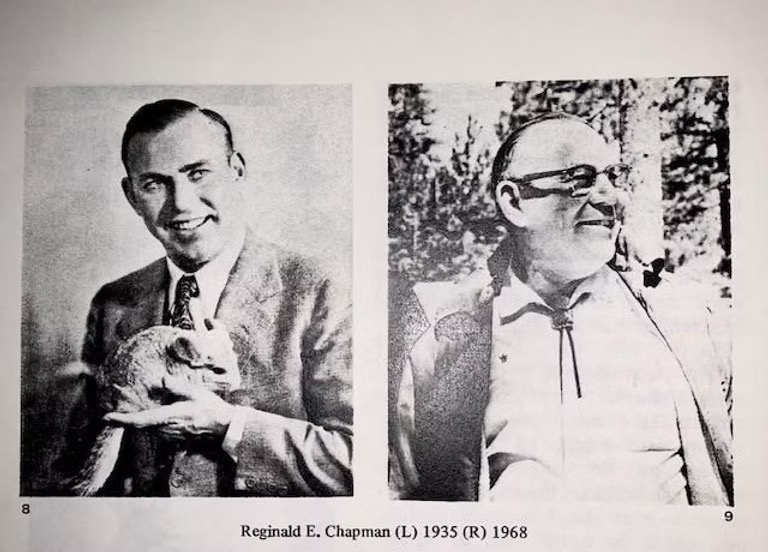
1918 saw an American working in Chile, called Mathias Chapman, meeting his first chinchilla. He was fascinated and intrigued by the inquisitive and beautiful little creatures. It was this fascination which led to the long and arduous process of capturing and eventually gaining permission to export 11 chinchillas to California (which he accomplished in 1922).
The journey for the chinchillas was a difficult one and Chapman spent most of the trip down in the hold with the chinchillas, ensuring their (relative) comfort. This included using huge blocks of ice to keep them cool. Despite the difficulties, Chapman persevered and started up the first chinchilla ranch in the US. Thus, the chinchilla fur farming industry came into existence in 1923.
Over the next few decades more chinchilla ranches were set up in the US, in Canada, and in Europe. In the late 1950s and early 1960s colour mutations began to appear in various ranches and the standard grey chinchilla with it’s pure white contrast belly was joined by the Tower Beige, Wilson White, Gunning Black, Larson Sapphire, Sullivan Violet, Broucke Charcoal Brown etc.
Happily for the chinchilla, there are no chinchilla farms in the UK now due to legislation prohibiting the raising of animals for pelting. There are several breeders in the UK however, who have considerable numbers of chinchillas, but these are now bred mainly for the pet market and for showing.
The chinchilla is still classed as an “exotic” but they have become increasingly popular as pets. They are intelligent, charming, highly inquisitive bundles of mischief, and have distinctly individual characters. Their curiosity is a delight to watch when they are investigating a new toy, a new cage or exercise environment and there is nothing more magical than touching or stroking the soft fur on a chinchilla’s chin whilst they close their eyes in contented bliss.
Whilst the number of domestic chinchillas is growing due to their popularity as pets and their continued use for the fur trade (in countries other than the UK), wild chinchillas are listed as an endangered species. Chinchilla populations in the wild have been decimated by past hunting and trapping for fur but the biggest current threat to their continued survival is habitat destruction.
The plight of the chinchilla in the wild is internationally recognised. A new project led by the Zoological Society of London has been launched. Called the EDGE project (Evolutionarily Distinct & Globally Endangered), it seeks to raise awareness and conservation for the “forgotten” animals which are literally on the edge.
” EDGE species are truly one of a kind. If they disappear there will be nothing similar left on the planet. Two-thirds are receiving little or no conservation attention.”
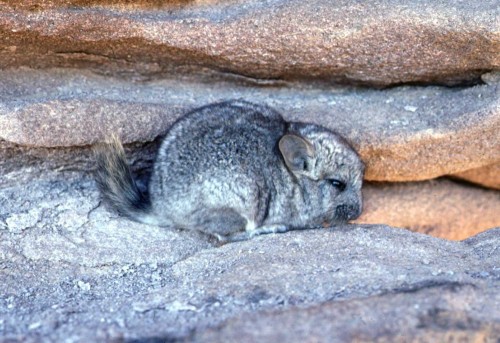
Interestingly, a recent scientific discovery has come across a previously undocumented colony of chinchillas in a coastal desert area of Chile. Currently the scientists are unsure if the colony of long-tailed chinchillas is a subspecies or a new population far away from their relatives in the upper Andes.
Chinchillas as Pets
Figaro in his stack-a-fuzzGzifa exploring chinchilla eating dried flowerTheo chinchilla sleeping in his cageGzifa exploring a small space behind a desk
Do chinchillas make good pets? Absolutely, for adults. For children, they do not make good pets.
Chinchillas can be flighty, fast, and awake all night – they have delicate bone structures that are easily crushed by rough handling. They do not sit on your lap like other pets and much prefer to have free out-of-cage time to explore. They will use you as a climbing frame and bounce off your leg, shoulder, head to get where they want.
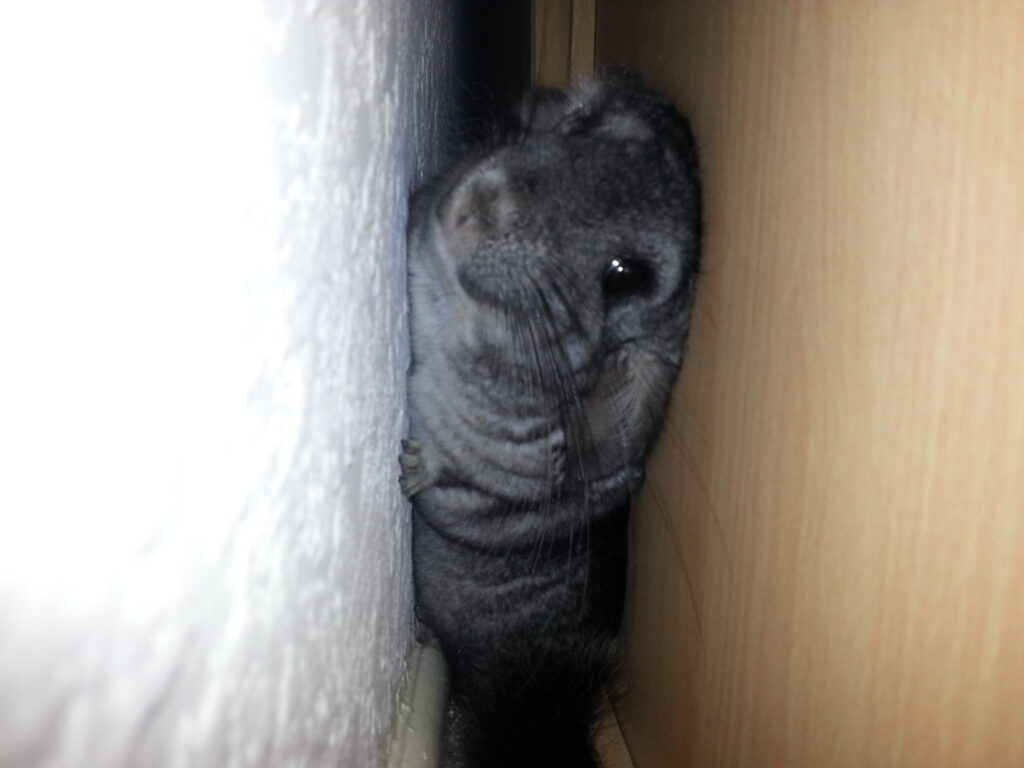
Chinchillas are shy but curious. They are determined and will explorer the smallest area if they think there is something of interest there. They like height and will climb tight spaces between a wall and cupboard or desk, popping out at the top to peer down at you. Sometimes they require rescuing from high places – so it is important that any exploration space is safe. Chinchilla-proofing a room can take time. They also love stairs, zooming up and down them at great speed.
Gzifa playing on the stairs.
Some chinchillas bond to their owner, some will be aloof; one of the great things about chinchillas is they have individual characters and getting to know them is part of the fun of being a chinchilla owner.
Chinchilla: History, Husbandry , and Marketing” by Edwin G. Bowen and Ross W. Jenkins (1969), released and published by Shoots Chinchilla Ranch in March, 1988.
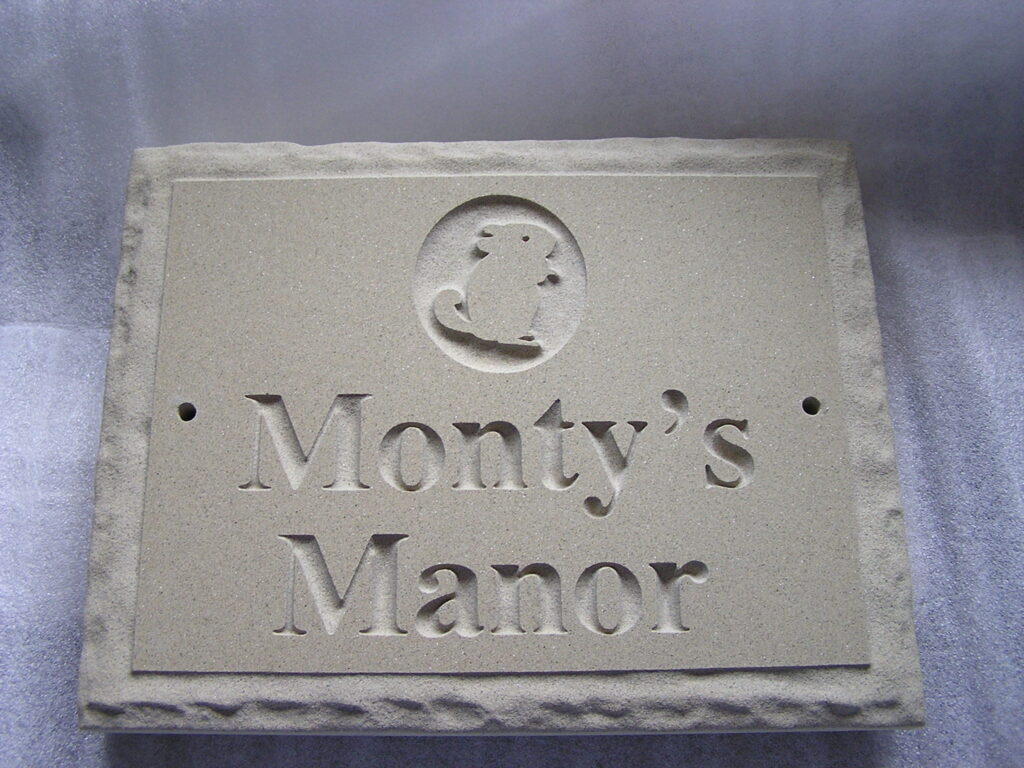
The CHINformative chinchillas live in a purpose-built unit that is affectionately known as Monty’s Manor. The unit has air conditioning, as well as temperature, and video monitoring, and a digital radio. The air conditioning can be activated remotely so that the chinchillas can be kept at an appropriate temperature in our warm, humid UK climate. The radio is also remotely accessed so that the chinchillas have some sound on all the time – this is especially useful during periods of active fireworks when the radio gets turned up a bit to reduce the risks of noise-related stress.
The chinchillas also have custom built cages so that pairs and individuals can be kept together or with a pop-hole separating both sides of the cage. Since chinchillas are herd animals, the chinchillas are kept in same sex pairs or individually, depending on their temperament; some chinchillas just don’t get on together but they can still have company with the chinchilla in the adjoining cage.
The CHINformative herd consists of pedigree breeding chinchillas as well as a few (not-for-breeding) rescues/rehomes. Claire has bred chinchillas for a number of years, however, stopped during COVID. The chinchillas in the CHINformative herd range in age from four to twenty years. Credric is an ebony chinchilla who is the youngest in the herd at 4 years old. In contrast, Chavin is a little charcoal chinchilla who will reach the grand old age of 21 in August, 2026.
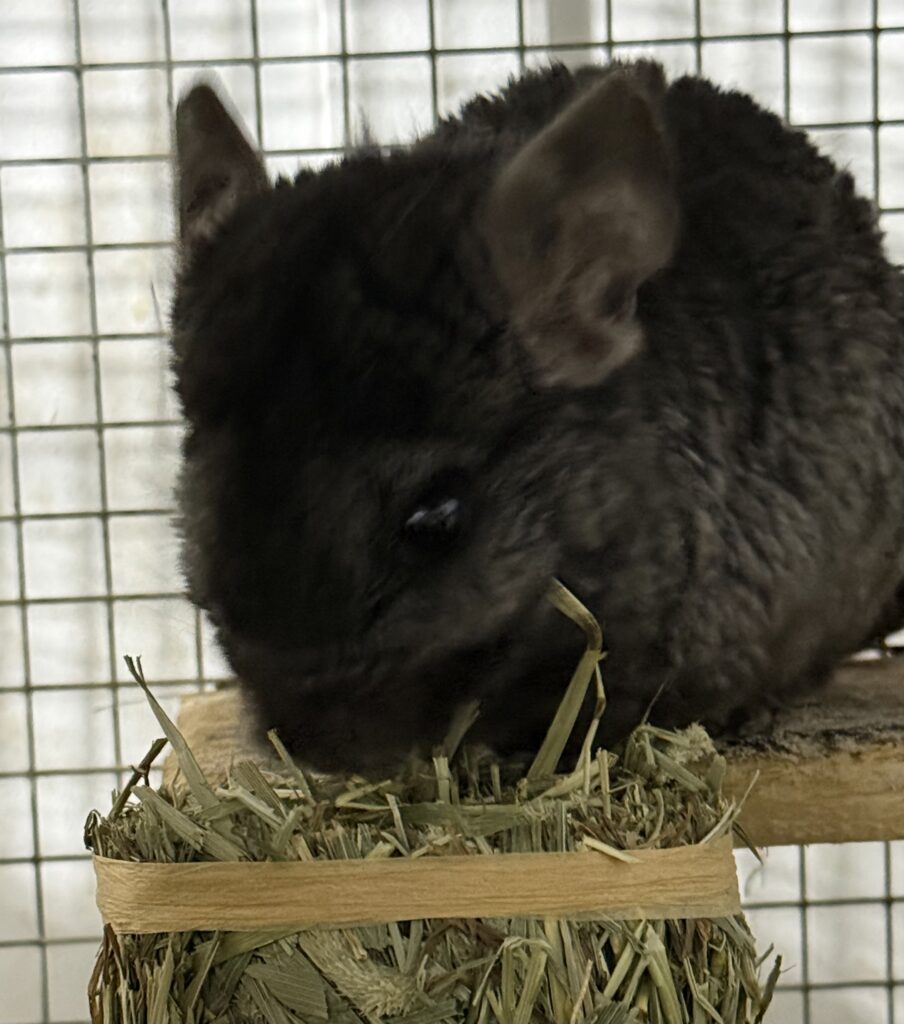
Slightly blurry photo of 20 year old chinchilla, Chavin, nibbling on hay.
Other notable characters in the herd include Mr Mac, an ex-breeding 13 year old standard male, who is taking his retirement very seriously. In other words, he’s lazy and often refuses to get off his bed when his cage is being cleaned out. He always makes us smile. In fact, the photo below shows his favourite position – on his bed, fast asleep, tail and bottom only visible.
Mr Mac’s favourite place – his bed!
Then, there’s Maleficent (Mallie for short) who is a rescue black velvet female chinchilla. She is a real character who displays stress behaviour and chews her fur as a result. She likes being spoken to and approached in a calm, gentle manner. If she’s startled, she will often spray urine in an attempt to fend off whatever is coming into her cage (her territory).
When she is in the mood, Mallie will approach your hand, pitter-pattering on it with her paws – as demonstrated in the video here.
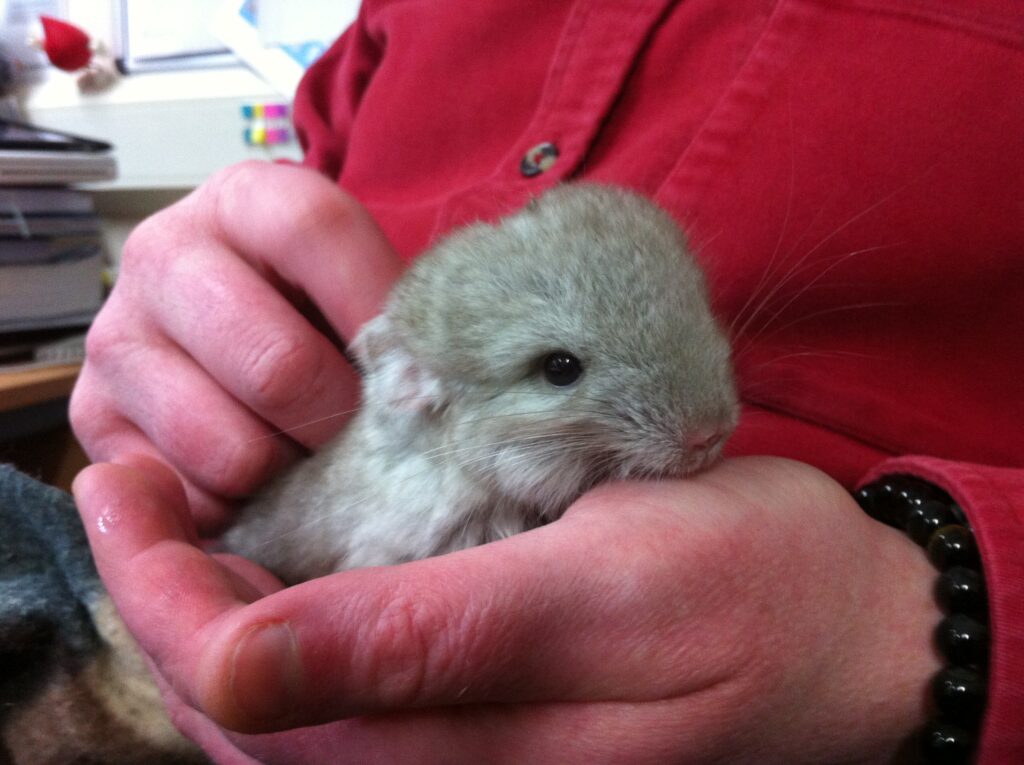
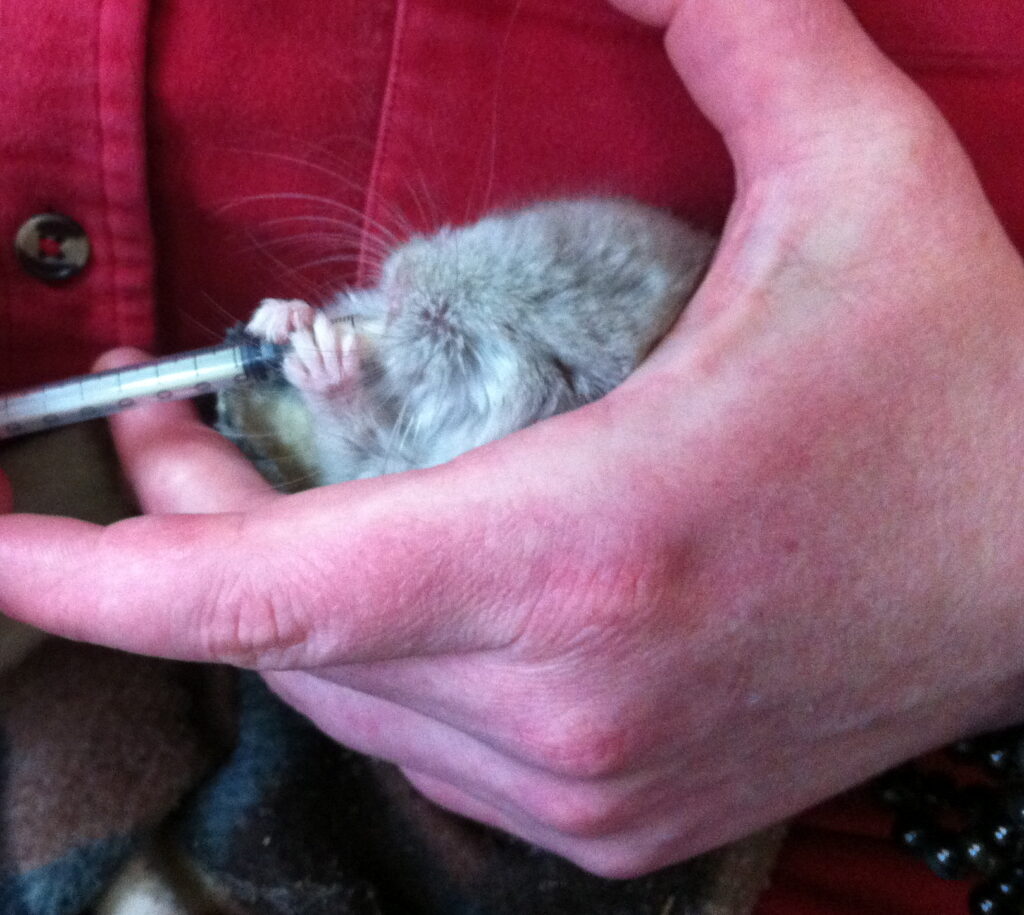
One last CHINformative character to mention here is Figaro (Figgy). He is a teenage beige charcoal carrying male chinchilla who was hand reared when his mother sadly died three days after he was born. As a young kit, Figgy spent much of his time snuggled with Claire between hand feeds. You would think that being so close, Figgy would be a very friendly chinchilla who loves to be held, however, the truth is Figgy does not appreciate being held at all and will try to avoid being handled.
Figaro as a 13 year oldFigaro as a young kitFiggy (Figaro) taking a hand feed.
In 1997 I purchased my first chinchilla, The Lord Montague, otherwise known as Monty to his friends. He was amazing.
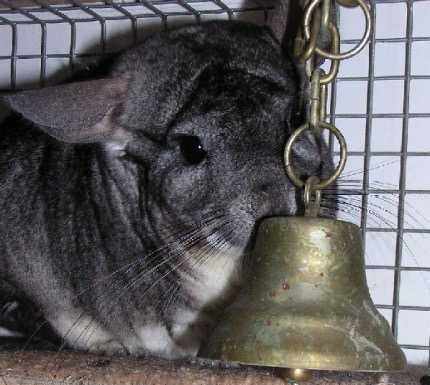
Owning Monty was a revelation and I soon learned that he was an absolute character. He was intelligent, inquisitive, sometimes agile, and absolutely terrified of being picked up! He often held his right ear down on his head as if he was indicating to turn right.
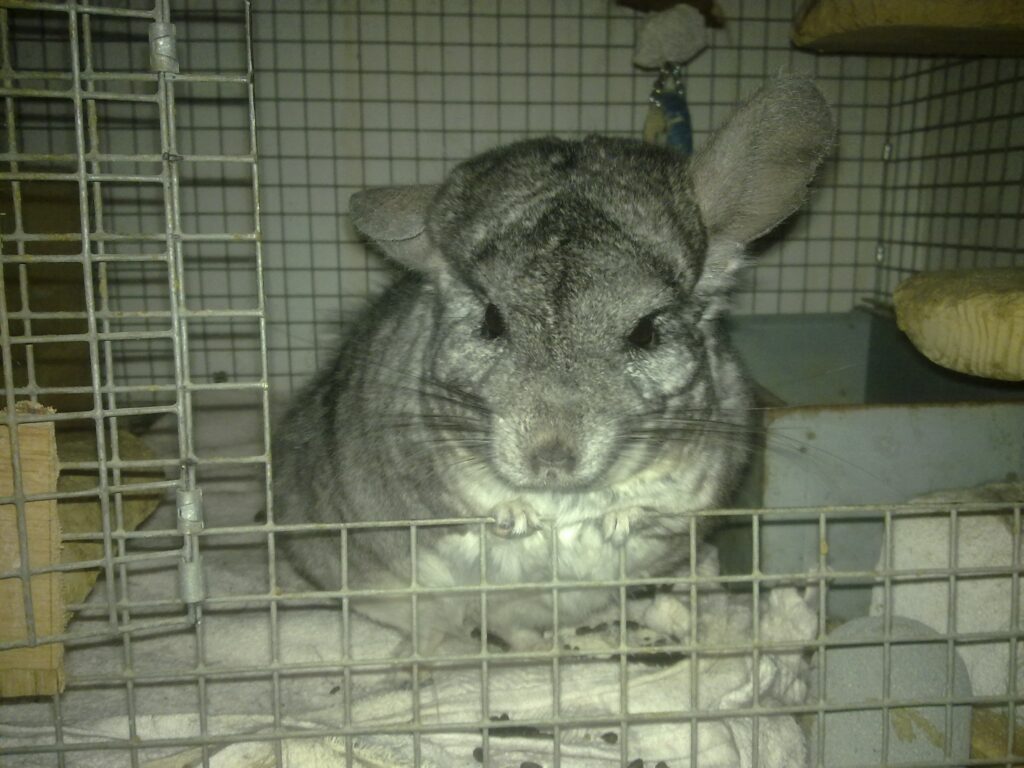
Monty in his cage – demonstrating his “indicator” ears.
When I first brought Monty home there was very little information available about chinchillas. I had to scour the internet and what I found was often contradictory or (as I now know) down-right wrong. Monty spent most of his time outside of his cage when I was at home, pottering around after me or looking for ways to get into mischief. One particular favourite hobby was trying to get into spaces that I didn’t think he could fit into – an early lesson in not underestimating a chinchilla’s dedication to squeezing into tight spaces. I spent quite a lot of time in the early days extracting Monty from behind the sofa or from underneath my TV cabinet.
As time went on I began to understand that looking after chinchillas relies on observational skills: watching, listening, and checking plays a huge part in chinchilla care. I got to know Monty’s normal behaviour so that when he became ill, I knew to take him to the vet.
Monty had developed a heart condition which was treated successfully with medication for almost a year. Just before his 13th birthday he looked tired and he did not behave in quite his usual manner. I made the decision to have him euthanised that day. My vet and I discussed possible further treatment but we both agreed the time had come. I was permitted to stay with Monty as he slipped peacefully away.
During Monty’s lifetime, I rescued several chinchillas from poor situations and, after losing a young chinchilla to dental issues (malocclusion), I was determined to learn all I could about chinchilla health and welfare.
Today, the chinchilla unit is still known as Monty’s Manor and his legacy lives on. I continue to keep chinchillas, with each one being a unique character. Like Monty, they teach me something new each day and never fail to make me smile.